
Your Power to Know
A Solution to the Perspectives Paradox

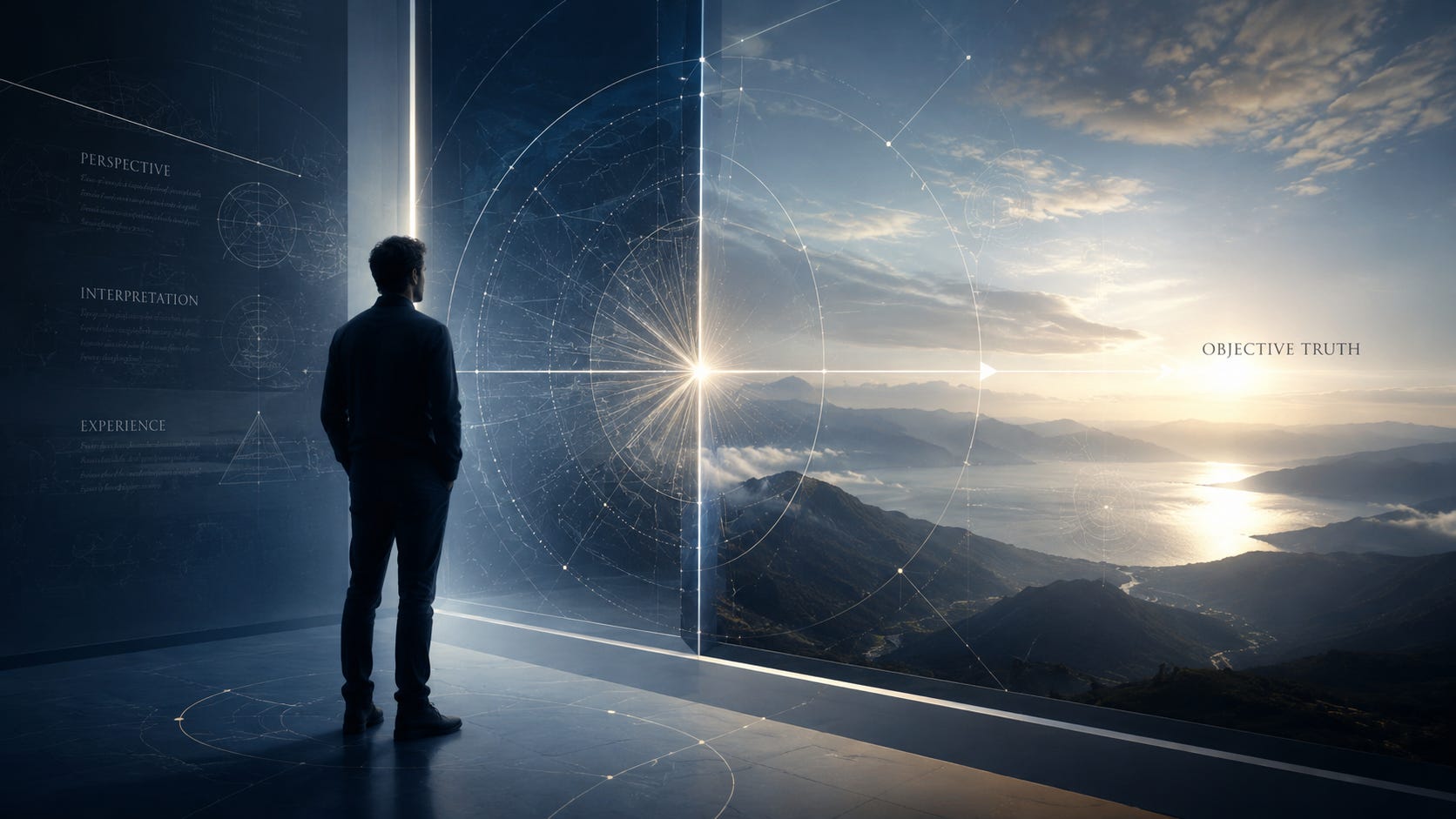
Here I offer a response to the Perspectives Puzzle that challenges the idea that you can know ANY objective truth outside your perspective. A solution to this puzzle would provide a fundamental understanding of your power to know anything. Enjoy!
To begin, I want to draw attention, paradoxically, to a principle of power about knowledge: you have great powers, including powers to know, to see, to understand, and to build insight about the topics you care about. This principle of the power is in tension with the puzzle of skepticism, but it is also valuable to your life. The tension between the puzzle and the value of your knowledge is why this inquiry is important.
About the value of knowledge: your power to know is foundational to so many other powers, including your power to navigate reality, to form a plan, to act on that plan, and to see the results. Suppose you want to build a house, a relationship, or a boat to cross a river. In each case, the success of your plan depends on how well the plan connects with reality. If your plan does not align with reality, then even if your boat looks good, it may not be designed for the actual river. The river may crash the boat, and you will not reach the other side.
The power to know is like the power to gain resources. People often inherit limits in their beliefs about what they are capable of, what paths are available, and what habits or patterns define them. Sometimes these limits come from peers, teachers, crowds, or experts who say, “This is the road to follow.” But that road may contain unnecessary restrictions. There may be other roads, other pathways, and other ways of building. By understanding the foundations of your power to know, you also gain resources to build new paths to knowledge.
So gaining knowledge about reality is important, but how do you do it—practically and theoretically?
Conscious Awareness as a Window
Before revisiting the puzzle, I want to draw your attention—for your consideration—to a foundational tool for knowledge: conscious awareness. Conscious awareness is a window into aspects of reality. You may be conscious of your thoughts, your feelings, your intentions, or your experience of an outer world. In each case, consciousness opens a window onto something: thoughts, feelings, intentions, colors, sounds, memories, possibilities, or patterns of reasoning.
This power of awareness puts you in the driver’s seat of your knowledge. You can steer and direct this power. For example, you can focus your awareness on a particular thought. You can ask, What is this thought? How is it connected to other thoughts? What follows from it? As you ask these questions, you can zoom in and gain further understanding.
You can use this basic power of awareness to inspect how you feel. You can use it to inspect a line of reasoning. For example, you can recognize that if two people got on a bus, and two is greater than one, then more than one person got on the bus. You can see this inference in your mind.
You can also direct your awareness by turning your eyes, moving your body, directing your attention, and seeking to find out more about a domain. Where your attention goes, your awareness flows.
To illustrate this power of awareness further, consider that you can also notice that this inference differs from a bad, inaccurate one. Suppose someone said, “Two people got on the bus, and two is greater than one, so nobody got on the bus.” That inference is repugnant to your mind. You can recognize the difference between the inference that flows through and the one that does not.
This recognition of difference is itself an act of awareness. You can see that one inference is not the same as the other, just as you can see that blue is not the same as red, or that feeling alive is not the same as a pine cone.
The power of awareness is so familiar that it is easy to miss its significance. In general, it is easy to mistake the familiar for the insignificant. Awareness is familiar. But it is very significant: your awareness is the foundation of everything you ever know.
Barriers to Knowledge
The Puzzle of Perspectives creates a barrier to knowledge. Before I zoom in on that barrier in particular, it is helpful to recognize a general pattern of limitation: barriers to knowledge roll in and create self-limitations.
For example, I often see people restricting their powers to know by inherited rules about where knowledge can come from. One rule says that knowledge can come only from experts who have published their findings in reputable places. This rule is too restrictive. You could not even know whether you feel excited, interested, or curious if you had to wait for experts to research your own feelings and publish their results.
To be clear, there are domains where you do not have direct access, and others may have access you lack. In those domains, you may need testimony, research, or expert guidance. But the problem comes from simplified rules that block people from seeing other sources of knowledge.
Another rule says that you can know only what you see with your eyes, or perhaps what you can hear, taste, smell, or touch. But this leaves out other modes of knowing. You can know that if two is greater than one, and two people got on the bus, then more than one person got on the bus. You do not need to see the bus, smell it, touch it, or taste it. You can see the inference through reason.
We can set aside the standard empiricist and rationalist debates for now. Those debates often carry conceptual overlays that can cloud the clarity of what is immediately available in awareness. Indeed, awareness itself gives you the power to navigate those debates, to see insights on both sides, and perhaps to bring them together.
In the interest of modesty, I will not claim here that conscious awareness is required for all kinds of knowledge. My own working hypothesis is that, for each person, knowledge is fundamentally built through conscious awareness. We can set that hypothesis aside here. At the very least, conscious awareness is a foundation for a certain kind of knowledge central to your perception of reality.
The Perspectives Puzzle of Skepticism
Let us now return to a skeptical puzzle. The puzzle creates a tension between two ideas. On the one hand, you seem to have a power to know truth. On the other hand, the skeptic proposes that you do not really have such a power because truth exists independent of your perspective—i.e., beyond your conscious awareness.
We can formulate the skeptical argument this way:
Either truth depends on your perspective, or it does not.
If truth depends on your perspective, then you do not know truths beyond your perspective.
If truth does not depend on your perspective, then you still do not know truths beyond your perspective, since you access truth only through your perspective.
Therefore, you do not know truths beyond your perspective.
The key thought is that you cannot know what lies outside your perspective.
I present this puzzle not to deepen uncertainty for its own sake, but to create an opportunity to see more clearly how knowledge works.
The very tension of the puzzle creates an opportunity for wisdom. People often respond to tension by running from it, or by simplifying it too quickly. One person may say, “Obviously we know things. I know that I am thinking. I know that I am wondering whether I know. If I doubt, I know that I am doubting.” From this perspective, any skeptical argument against knowledge seems doomed from the start.
Another person may say, “The skeptical argument is powerful. It shows that we do not really know. Therefore, any attempt to defend knowledge must fail.”
But in my experience, where there is tension, there are insights to find from both sides. Wisdom often flows through tension. When you feel the pain of uncertainty, you may be close to growth in understanding, provided you enter the uncertainty with the intent to understand more. That intent matters because it directs your attention. It brings consciousness into the uncertainty, where insight can be found.
Often this process is spiral-shaped. You begin to unravel something. Then you unravel another layer. Then another. Sometimes the first insight is simply seeing that there is a puzzle.
The “Window of Awareness“ Solution
In general, I find that insight often comes from clarifying a distinction that was blurred. Sometimes, when you look at a forest from far away, the trees blend together. You cannot see their differences because you are too far away. Something similar happens in philosophical puzzles or in other puzzles in life, such as puzzles about relationships. We need to draw attention closer, inspect the argument, and distinguish what has been run together.
In this case, my solution to the Perspectives Puzzles begins with a distinction between two ideas that are related but importantly different. The crucial distinction is between truth being in your perspective and truth being dependent on your perspective. These are different concepts.
I will grant, at least for the sake of argument, that whatever you consciously know is in your perspective. For your conscious awareness helps define your perspective. When something comes into your awareness, it comes into your perspective. So, if you know something through awareness, then in some sense it is in your perspective.
But does it follow that the thing known depends on your perspective?
It does not. So far, we have not considered the possibility that you could know a truth that is in your perspective but that does not depend on your perspective. This distinction is the key.
To illustrate, think of a window. Imagine you look through a window and see a tree. The tree is in view through the window, but the tree does not depend on the window or your view. The window could be removed, as could your view, and the tree would remain.
In the same way, conscious awareness can function like a window. Things may come into the window of awareness. They may appear within your perspective. But it does not follow that they depend on your perspective for their existence or truth.
To see this distinction clearly, consider a logical inference. For example: if two people got on the bus, and two is greater than one, then more than one person got on the bus. This inference can come into your awareness. While it is in your awareness, you can see that it is true. You can see that 2 > 1, and you can see the possible application to people on a bus. You see this by the light of reason right within your conscious awareness.
But notice: the truth of the inference (that the inference is valid / accurate) does not itself depend on your seeing it. One thing you can notice in awareness is that the logical inference has stability. Indeed, it seems to hold necessarily: in any possible circumstance, 2 > 1. Therefore, the relation between two and one is not made true by your awareness of it. Your awareness, by contrast, does not hold necessarily. You can also recognize that your awareness comes and goes. You may think about the inference now and forget it later. You may be asleep tomorrow morning and not think about it at all. But the logical inference still holds.
From here it follows, by logic, that you can see within consciousness a logical inference that does not depend on your conscious awareness of it. Logic exams have true answers on Mondays, Tuesdays, and Wednesdays, even when you are not thinking about them. In other words, logical truths do not depend on your awareness of them.
This example illustrates the broader point. In general, you can know something that comes into your perspective, even if that thing does not depend on your perspective.
On this analysis, the problem with the skeptical argument is with premise 3:
If truth does not depend on your perspective, then you still do not know truths beyond your perspective, since you access truth only through your perspective.
My solution incorporates, rather than brushes aside, the insight of the skeptical worry. The insight is this: knowledge based on awareness depends on things entering your perspective—i.e., entering your conscious awareness. In short, knowledge is born in awareness.
Then we add the key distinction: something can be known based on being in your awareness even if the thing known can exist without depending on your awareness. In this way, you can see how you can know something that does not depend on your awareness, even while awareness is at the foundation of what you know.
Or put another way: truth can be objective, independent of your perspective, even while your sight—awareness—of truth is subjective, dependent on your perspective.
This distinction gives us a deeper insight into how knowledge works. Often, insight comes through careful distinction. We separate one concept from a related concept. We see how two things that seemed fused together are actually different. Once we separate them, the Perspectives Paradox no longer blocks the path to your power to know.
How to Know Your Name
This solution leaves open many questions about reality and knowledge. For example, what exactly happens when you see a tree through the window of awareness? What is the nature of the tree? Does the tree itself exist apart from your awareness? Does your experience present the tree directly, indirectly, or in some other way? When you are aware of shapes and colors in a dream, are those real shapes and colors, or only dream shapes and colors?
These are important questions, and I address them elsewhere (See “Your Perception,” in Who Are You, Really?). We can set them aside for my purposes here.
The central idea here is flexible. Whatever you think about the nature of perception, and whatever you think about the nature of reality, you can recognize the difference between being in your awareness and being dependent on your awareness.
What I offer in closing is an application of my solution to the question, “How do you know your name?” You know your name by applying your awareness to two things:
Experience: your experiences with your name, such as hearing it and being told your name by your parents.
Inference: your inference from your experiences to the most likely explanation of them.
Both—experience and inference—take place in your awareness. As we saw earlier, logical inferences hold in a stable way that is not dependent on your experience of them. It is part of your experience of a logical inference to experience its stability as distinct from your awareness. Thus, your awareness is a window into a reality within you—your experiences—that also points, via inference, to a reality beyond you: the truth about your name.
Note that this account allows you to have knowledge that is not infallible. The knowledge here could be probabilistic—the most likely truth, given your total evidence.
For the sake of modesty, we could also leave open whether there are different types or grades of knowledge. Strict knowledge, one might think, requires complete certainty, while a more general practical knowledge requires only a certain high degree of likelihood. For our purposes, we can leave that open. If someone has a strict view of “knowledge,” then the result of my analysis is that you can know, or have awareness of, at least what is likely to be your name conditional on your evidence. Either way, you are not stuck in the dark, without any way to gain knowledge, or likely knowledge, of yourself or the world beyond yourself.
Conclusion
To recap, your awareness is a real power to know: it lets you inspect experience, follow inference, and build insight about reality. The skeptical puzzle says you may be trapped inside your perspective, unable to know objective truth beyond it. But the key distinction, I suggest, is between what is in your perspective and what is dependent on your perspective. A truth can come into view through awareness without depending on awareness for its truth. So you are not trapped inside your perspective merely because you know from a perspective; through awareness, you can discover truths that exist independent of your awareness of them.
Whether you agree with every part of this analysis or develop another analysis of your own, I hope the distinction helps clarify the path. You are not trapped inside your perspective merely because you know from a perspective. Through awareness, you can discover truths that do not depend on your awareness.
Thank you for your consideration!
p.s., I am creating The Truth-Seeker’s Guide to Power for people who want to grow in clarity when life’s deepest questions feel confusing. This course will be provide you a systematic guide to your powers in a series of steps in a personalized way.
More Resources
Descartes, René. Meditations on First Philosophy. 1641.
Classic source for modern skepticism, certainty, and foundationalism.Gettier, Edmund L. “Is Justified True Belief Knowledge?” Analysis 23, no. 6 (1963): 121–123.
The classic paper that launched the Gettier problem.Goldman, Alvin I. “A Causal Theory of Knowing.” The Journal of Philosophy 64, no. 12 (1967): 357–372.
A classic externalist response to Gettier-style problems.Plantinga, Alvin. Warrant and Proper Function. New York: Oxford University Press, 1993.
A major account of warrant in terms of proper cognitive function.Fumerton, Richard. Metaepistemology and Skepticism. Lanham, MD: Rowman & Littlefield, 1995.
Important defense of internalism and acquaintance-style foundationalism.Huemer, Michael. Skepticism and the Veil of Perception. Lanham, MD: Rowman & Littlefield, 2001.
A clear defense of direct realism and response to perceptual skepticism.Williamson, Timothy. Knowledge and Its Limits. Oxford: Oxford University Press, 2000.
A central source for knowledge-first epistemology.Simion, Mona. Knowledge-First Epistemology: A Defence. Cambridge: Cambridge University Press, 2025.
A very recent defense of knowledge-first epistemology.
Josh, What is the chapter number for "Your Perception,” in "Who Are You, Really?" I am not finding it in the first edition. Perhaps you mean the chapter "Your sight", chapter 4 then